


Driving Efficiency & Cost Control through Pallet Wrapping Solutions
- june 9, 2026
- Packaging Machinery
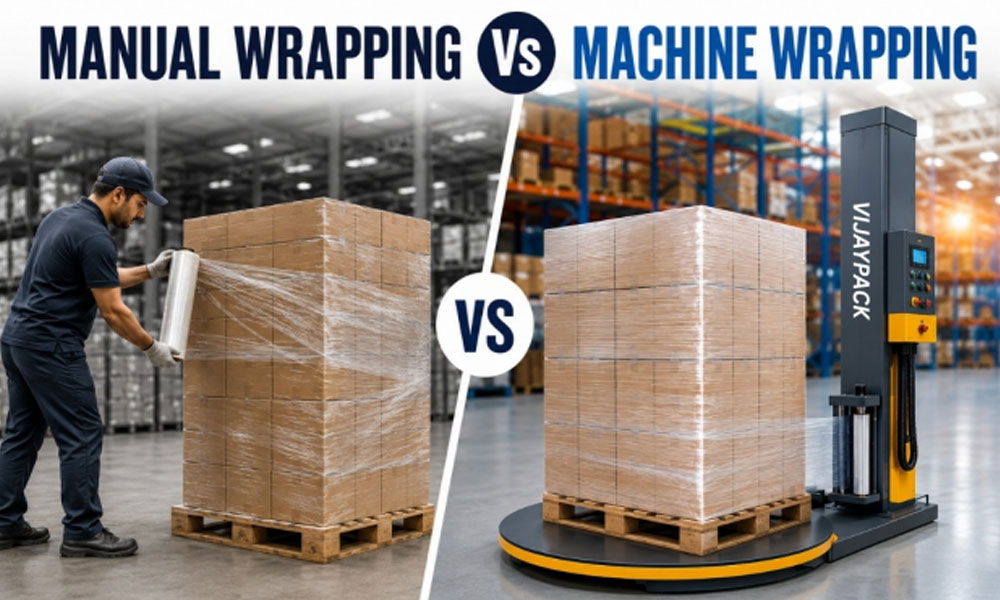
Pallet Wrapping vs Manual Wrapping: The Real Cost Advantage
In high-volume packaging operations, pallet wrapping is a significant cost driver that directly impacts efficiency, resource utilization, and product safety. While manual wrapping may appear cost-effective at the outset, a deeper cost analysis reveals substantial hidden expenses associated with excessive material usage, higher labour dependency, and operational inefficiencies.
A structured comparison clearly demonstrates that pallet stretch wrapping machines deliver measurable Cost Savings, Enhanced Productivity, and Superior Load Security—positioning them as a strategic investment rather than a recurring expense.
Material Cost Optimization – The Primary Driver of Savings
Material consumption is one of the most critical contributors to packaging cost. Manual wrapping, being highly dependent on operator skill and effort, often results in inconsistent film application. This leads to overwrapping, wastage, and increased expenditure.
A detailed cost analysis indicates:
- Manual Wrapping Annual Film Cost:₹21,60,000 (₹36 per pallet)
- Machine Wrapping Annual Film Cost:₹12,09,600 (₹20.16 per pallet)
- Annual Savings:₹9,50,400 (Savings of ₹15.84 per pallet)
These significant savings are achieved through Pre-Stretch Technology and controlled film tension, which ensure precise and optimal film usage for every pallet, eliminating unnecessary wastage and improved cost efficiency.
Reduced Labor Cost & Operational Dependency
Manual pallet wrapping is inherently labor-intensive, requiring multiple operators and continuous physical effort. This not only increases recurring labor costs but also creates dependency on workforce availability and consistency.
In contrast, pallet wrapping machines streamline the process, enabling a single operator to efficiently manage multiple loads. This reduces manpower requirements, enhances operational control, and allows businesses to redeploy labor towards higher-value activities.
Higher Output & Enhanced Operational Efficiency
Manual wrapping processes are comparatively slow and physically demanding, often limiting throughput and creating bottlenecks in dispatch operations.
Pallet wrapping machines operate at significantly higher speeds, delivering:
- Faster and consistent wrapping cycles
- Increased daily output
- Smooth and uninterrupted workflow
This improvement in speed and consistency enables businesses to optimize throughput, meet demanding schedules, and maintain a more efficient packaging line.
Uniform & Secure Packaging (Minimized Damage & Pilferage)
In manual wrapping, inconsistent film tension and uneven layering can result in unstable pallet loads. This increases the likelihood of transit damage, product displacement, and pilferage.
Machine wrapping ensures uniform, tight, and consistent packaging, significantly enhancing load stability. As a result, businesses benefit from reduced product damage, minimized losses, and improved delivery reliability across the supply chain.
Comparative Study: Manual vs Machine Wrapping
Parameter | Manual Wrapping | Pallet Wrapping Machine |
Annual Film Cost | Rs. 21,60,000/- | Rs. 12,09,600/- |
Annual Savings | – | Rs. 9,50,400/- |
Material Usage | High & Inconsistent | Optimized & Controlled |
Labour Requirement | Multiple Operators | Single Operator |
Output | Low & Slow | High & Consistent |
Wrapping Consistency | Uneven | Uniform & Precise |
Transit Damage Risk | High | Minimal |
Pilferage Risk | Higher | Significantly Reduced |
Overall Efficiency | Low | High |
Conclusion:
The analysis clearly establishes that manual wrapping, despite its low initial investment, results in higher long-term costs due to inefficiencies in material usage, labor, and productivity.
Pallet stretch wrapping machines, on the other hand, deliver direct and quantifiable savings of approximately ₹9.5 lakhs annually, while also enhancing operational efficiency, reducing labor dependency, and ensuring superior packaging quality.
For organizations focused on scalability, cost optimization, and operational excellence, machine wrapping is not merely an upgrade—it is a strategic necessity.
Recent Post
Palletisation & Stretch Wrapping: Solving Everyday Logistics Challenges