


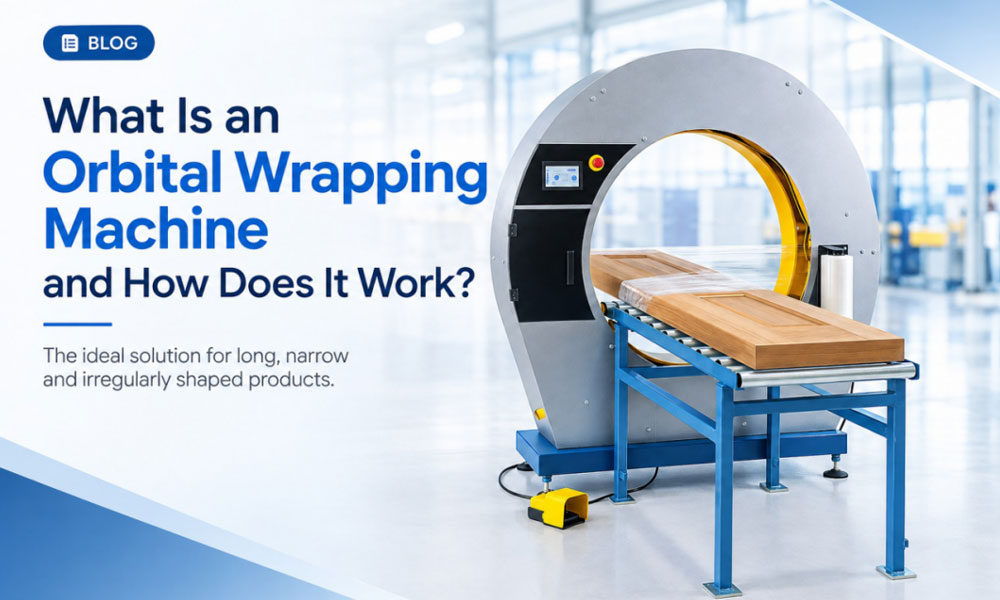
What Is an Orbital Wrapping Machine and How Does It Work?
- September 29, 2026
An orbital wrapping machine is a packaging system that wraps stretch or spiral film around a product by rotating the film itself in a circular motion — instead of rotating the product, like a standard pallet wrapper does. It’s built specifically for long, narrow, or irregularly shaped items that don’t fit neatly onto a turntable.
How It Works
The product is placed horizontally through the machine, usually via a conveyor or an infeed table. A rotating ring — the core of the machine — carries the film reel(s) around the product in a continuous circular motion, wrapping it layer by layer along its length.
This is the opposite of how a standard pallet wrapper works. In a pallet wrapper, the load sits on a turntable and rotates while the film stays fixed. In an orbital wrapper, the load stays still (or moves steadily through on a conveyor) while the film rotates around it. This is what makes orbital wrapping suited to items that are too long, too heavy, or too awkwardly shaped to spin safely on a turntable.
As the ring rotates, the machine controls film tension and overlap to keep the wrap tight and consistent along the entire length of the product, without gaps or loose sections.
Key Components
- Orbital ring– the rotating frame that carries the film around the load
- Film carriage/reels– holds the stretch or spiral film; automatic models often use twin reels for continuous, uninterrupted wrapping
- Conveyor or infeed/outfeed table– moves the product into and out of the wrapping zone
- Control panel– manages speed, tension, and cycle settings, especially on semi-automatic and fully-automatic models
Types at a Glance
- Manual/semi-automatic orbital wrappers– an operator loads the product and starts the cycle; suited to smaller operations or lower wrapping volumes
- Fully-automatic orbital wrappers– integrated into a conveyor line, these thread, wrap, and cut the film with no operator involvement, built for high-volume, continuous production
We’ve covered the differences between semi-automatic and fully-automatic orbital wrappers in more depth in a separate post — worth a read if you’re deciding between the two.
What It’s Typically Used For
Orbital wrapping machines are built for products that don’t wrap well on a standard pallet wrapper: pipes, tubes, steel coils, window and door frames, mouldings, bundled profiles, and other long or grouped items.
In sectors like steel and construction, this often means securing coils, rods, or bundled sections for transit — where a consistent, tight wrap matters for protecting the product from moisture, dust, and shifting during transport. In logistics and FMCG, it’s commonly used for bundling and securing grouped or irregular packages before dispatch.
Why Manufacturers Use It
The main draw is consistency and speed. Manual wrapping of long or bundled items is slow and labor-intensive, and the result varies from one operator to the next. An orbital wrapper delivers the same tight, even wrap every time, cuts down on labor, and reduces damage in transit — which matters when you’re shipping across long distances or through multiple handling points.
Conclusion
An orbital wrapping machine solves a specific packaging problem: securing long, narrow, or irregular loads that a standard pallet wrapper can’t handle well. If you’re currently wrapping these products by hand — or your existing equipment struggles with awkward shapes — it’s worth looking at where an orbital wrapper would fit into your line.
Call to Action
Explore Vijaypack’s range of orbital wrapping machines, or get in touch with our team to discuss which configuration suits your production volume and product range.